Team Development
Building Synergistic Teams That Deliver Impressive Results!
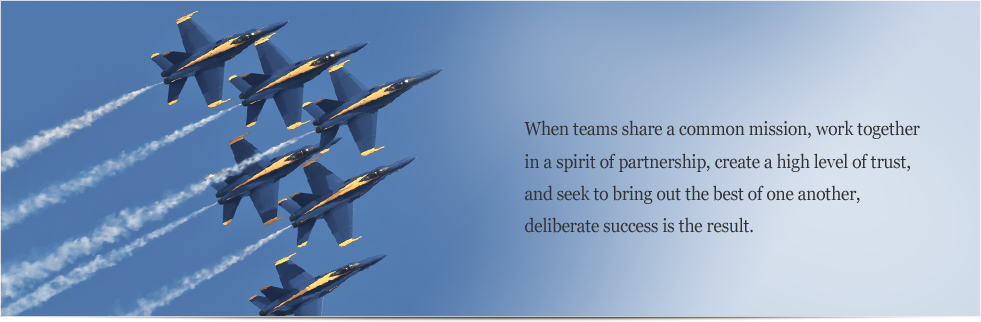
Whether it’s moving from “good to great” or facilitating a team to learn the fundamentals of working together effectively, team development can be a highly effective process in moving from where they are now to where they want to be. This pragmatic, participative, and insightful process emphasizes principles and strategies of building and sustaining high performance teams — tools that have stood the test of time and that can be applied immediately. When teams work together in a spirit of partnership, have a high level of trust and open communication, share a common mission, vision and values, and seek to bring out the best of one another, incredible results can be achieved.
When results count, count on Dr. Eric Allenbaugh to support your efforts in creating an even brighter future for your team – on both the bottom line and on the human element. Eric, a seasoned professional in personal and organizational transformation, will guide you in moving from where you are now to where you want to be. This transformational process effectively engages leaders and staff to collectively achieve positive, productive results. Principle centered, value driven, and solution oriented, the systematic process has lasting results long after Dr. Allenbaugh completes his work with your organization.
Team Development Process
The Allenbaugh Method of leadership and team development focuses on best practice principles and tools that have a long track record of success. While systematic and pragmatic, this is not a “canned process” of “one size fits all.” Every team is different, has different needs, and experiences a different culture. Deliberate efforts, therefore, are made to assure that your interests and outcomes are addressed while simultaneously tailoring the approach to your unique organizational culture.
To address your distinctive needs and interests, 4 Consulting Action Steps are applied: Assessment, Planning, Implementation, and Follow-Up.
Step 1: Assessment
Every organization is different. Given that, this leadership and team development process needs to reflect the unique factors that both contribute to and detract from overall effectiveness.
Typically, we begin the process through a series of Focus Group interviews with key leaders, staff, and other stakeholders to gain from their experience with and observations of the organization. Early engagement of key people tends to foster trust and ownership in the process. Data from these Focus Groups are useful in designing, in close collaboration with you, the next steps to assure we are on target in addressing your unique needs and interests.
Step 2: Planning
Following the assessment interviews with leadership, select staff, and key stakeholders, Dr. Allenbaugh typically prepares a report of his findings, including strengths, opportunities for enhancement, challenges, cultural norms, hopes, and concerns. These findings, together with your organizational knowledge and experience, provide a foundation for planning the implementation phase of the process. In this collaborative planning process, we typically identify or refine:
- What outcomes are we seeking to accomplish?
- Who needs to be involved?
- What content do we need to explore?
- What processes will assist us in achieving the desired results?
- What “deliverables” do we need to achieve?
- How do we keep the team and organization development process relevant and viable for the long term?
Step 3: Implementation
Depending on findings from the Assessment Phase and your active guidance, the Implementation Phase can take on a number of forms related to individual, team, and organizational development. Working closely with you, Eric will develop a “results roadmap” designed to achieve the outcomes you seek. The implementation phase varies widely — depending on your needs and interests. Typically, one or more of the following three developmental categories (Organization, Team, or Individual) are of high priority to Dr. Allenbaugh’s clients:
A. Organization Development
- Clarifying or reaffirming mission, vision, and values
- Building clarity of strategic direction and unity of purpose
- Assuring board and executive alignment, partnership, and commitment to a shared direction
- Identifying core strategies and implementation plans
- Creating and implementing organizational redesign
- Empowering leaders and staff within the context of accountability and stewardship
- Building understanding of and commitment to a strategic change process while working through resistance
B. Team Development
- Aligning individual with organizational mission, vision, and values
- Building committed, empowered, accountable teams
- Enhancing trust and open communications
- Facilitating team problem solving and decision making skills
- Building win-win conflict tools in addressing sensitive issues
- Teaching leaders to coach others effectively
- Enhancing skills in communicating and connecting with others whose styles differ
- Identifying present and future talents required and preparing individuals and teams to close the gap
- Building team synergy, creativity, and commitment to a new direction
- Developing team “Operating Agreements” for sustained results
C. Individual Development
- Providing focused, 1:1 executive coaching regarding organization and professional development issues
- Facilitating self-examination of talents, interests, fit, and commitment
- Implementing Personal Strengths Profile to assess strengths and stretches and to develop personal and professional development plans
- Balancing career and life issues
- Facilitating the process of difficult change in 1:1 coaching sessions
These three developmental categories are often augmented with other services described in this website, including Leadership Consulting, Executive Coaching, and Keynote Speaking. Taken together, these leadership, team, and organizational development tools can catapult your organization to the next level of purpose, passion and performance.
Step 4: Follow-Up
Team development requires systematic follow-up. Three forms of follow-up are typically built into the leadership and team development process to assure positive and lasting results:
A. Leaders internally implement principles, tools, and action steps identified in the core Team Development workshop.
B. We generally reconvene three to four months after the core workshop for a follow-up session of one or two days to explore new material, evaluate results compared with plans, celebrate successes, take corrective action, and prepare leaders to internally implement this self-renewal process on an on-going basis.
C. Dr. Allenbaugh periodically conducts individual executive coaching sessions to stretch leaders to perform at their optimal levels. Executive coaching provides additional tools to achieve and sustain individual, team, and corporate results.
How would the person I want to be
do the thing I’m about to do?”
— Jim Cathcart
To explore options for enhancing team effectiveness in your organization, contact Dr. Eric Allenbaugh at 503-635-3963.
Here is what Eric’s clients say about his team development workshops…
“Time with Eric always adds massive and immediate practical value. His general leadership seminars and consistently-productive meetings, professionally-tailored to the specific successes and growth areas of your leadership team, are just simply the very best out there. I have worked with Eric five times over fifteen years (usually with teams that are strong, and looking to grow – and once with a team that was flat out failing). In every context, he met with our team to really hear what we needed and wanted. And, most importantly, he delivered high-quality and useful insights – every time. Money and time very, very well-invested.”
— Steve Reinmuth, Senior Assistant Attorney General
State of Washington, Labor and Industries Division
“Eric will help you improve your employee’s individual performance,
and, more importantly, their ability to work together effectively.”
— Larry Kupfer, President & CEO
Virgin Islands Next Generation Network
“Eric – Please accept our sincere gratitude for your facilitation of our three-day leadership
and team development workshop. It was an exciting, empowering shared experience
with our team. We look forward to seeing these tools, concepts, and methods in use
– as well as using them ourselves.”
— Nathan Georges, President, Columbia Industries, LLC
— Ben Van Raden, Vice President & General Manager, Columbia Industries, LLC